

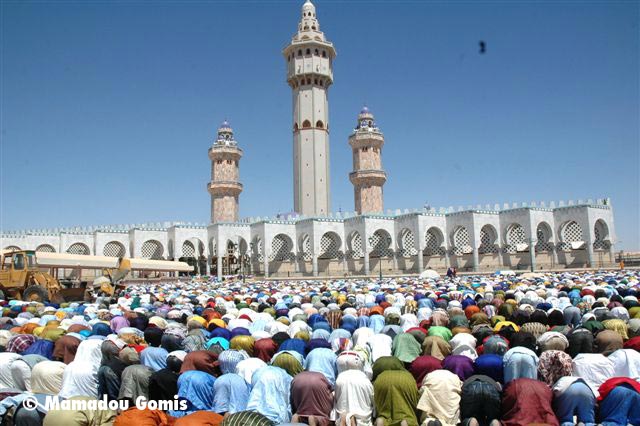
The inauguration of the University Complex Cheikhou Ahmadoul Khadim of Touba was done earlier this week, in the presence of the President of the Republic, Macky Sall, and the Khalifa General of Mourides, Serigne Mountakha Mbacké.This salutary initiative allows the establishment of one more university in our country, proving that there is no better investment than the education of men. In a country where public education, social elevator of many generations of Senegalese, is collapsing day by day and where insolent ignorance has poisoned all spheres, to see the erection of a university adapted to the reality of a region is enough to revive the faith in a Senegalese Republic of all possibilities.
The university complex of Touba is financed to the tune of 37.7 billion CFA francs on the basis of contributions from disciples, the Khalifa General and state support including a financial contribution of the Head of State to the tune of 1 billion CFA francs, and the commitment of the Senegalese state to conduct all the work of sanitation and roads. This temple of knowledge, reminiscent in its modelling of the universities of obedience very present in the United States of America, aims, according to its Rector, Serigne Badiwou Mbacké, to educate young people through a confessional education, by encouraging them to the cult of work and the acquisition of useful knowledge of our world. The invitation of Serigne Touba to work as if one were never to die will surely be written in gold letters in the coat of arms of the university.
The spirit of solidarity and trust, which animated the financing of this university, should spread to the conduct of various community initiatives in our country. This would be a guarantee of development, without the dependence on the hand of the State (although it is indispensable in any project for utilitarian purposes). Personalities such as the footballer SadioMané and many communities in Fouta and Eastern Senegal are already making a name for themselves by conducting development initiatives on a similar basis.
The Mouride community had already shown the way recently, with the construction of the Massalikoul Djinane mosque in Dakar. The university complex in Touba is another concrete materialisation of the spirit of this « relational economy » animating Mouridism, as presented by Felwine Sarr. Conducting productive or value-creating initiatives from « economic interactions based on the links that unite members », as Felwine Sarr puts it, offers other avenues for development that the classical economy cannot understand. The contribution of a disciple to an initiative carried out by his brotherhood for the realisation of a common project integrates a large part of trust. This trust is a determining factor in the vitality of an economy, in the capacity that its members have to associate and endorse each other. The nature of trust in Mouridismwould have been a good example for a thinker like Francis Fukuyama in his analysis of trust as a guarantee of economic virtues and the creation of prosperity, as he did for societies with a « high level of trust » between people (the case of Germany, the United States and Japan).
President Abdoulaye Wade, in his study on the economic doctrine of Mouridism, eloquently referred to the trinity of « science, prayer and work » as the basis for the community’s action from a clear moral foundation. Work is seen as an integral part of the realisation of the person in the social body in which he evolves, in his relationship with God and in his personal development. It is here a cardinal virtue sanctioning the cult of effort and full realisation in the face of trial.
It is impressive how the parallel between work in the Mouride spirit relates to the idea of work as an individual’s vocation in Lutheran Protestantism, as Max Weber was able to theorise through the notion of Beruf. The work of the individual is seen as the means to have his or her existence sanctioned by a divine blessing and the individual, through his or her vocation (Beruf), finds wholeness. The resonance of this vision of work with the writings of Serigne Touba in Massalik Al Jinan (The Paths to Paradise) is unmistakable, especially since it is said in the pen of the Sheikh that « abandonment to God does not exclude Kasb, work to earn bread ».
Work is a prayer, and many people have understood this, despite all the logic of the Mouridism that some would like to empty of its orthodoxy. The Sheikhou Ahmadoul Khadim University Complex in Touba is a material proof that trust is an essential factor in any logic of economic solidarity. Serigne AbdoulAhad Mbacké, the third khalifa, had popularised this model of subscription of the disciples in the great projects of their community during the extension works of the Mosque of Touba. Ways should be found to frame the strength of such solidarity economy mechanisms. We have seen the success of the Hizmet model in Turkey.
P.S.: I was surprised to receive a membership e-mail from the political group Pastef when I checked my inbox last weekend. The registration was done on my professional and personal emails. Nothing can surprise me anymore with these people who had to hack newspaper front pages or distort the song of a famous artist for their « cause », but the cowardice and the ridiculousness of the thing are staggering. I thought about filing a complaint with the Personal Data Commission (Cdp), but people close to me dissuaded me from doing so, so as not to give grist to the factory per excellence of forgery. What can we expect from dung beetles?
Serigne Saliou DIAGNE / saliou.diagne@lequotidien.sn


